The Industrial Spine of Italy: 9 Years of Data-Driven Observations
Back in 2017–2018, I spent a whirlwind period visiting some of the most prominent international manufacturing automation events: Hannover Messe (Hannover), SPS Expo (Nuremberg), and Achema (Frankfurt am Main). At the time, these trips were a mix of professional exploration and personal discovery. It was during that same period that I first experienced Italy, living in Rome for an extended time. This initial encounter sparked a deep fascination with the country, which later led me to complete my postgraduate specialization in ICT for Development at the University of Turin. Against the backdrop of my professional development, I vividly remember the constant travel between Rome and Germany. I was transitioning between the raw scale of global industrial engineering events in Germany and the practical, on-the-ground reality of my own engineering work.
Geospatial Analysis of Italian Exhibitors at SPS Expo (Nuremberg)
Those early experiences left a lasting impression, not just of the technology, but of the geography behind it. Curious about the origins of these industrial players, I scraped a list of Italian exhibitors from the SPS Expo (SPS - Smart Production Solutions) dataset and mapped them. The result—Fig. 1—truly shocked me then, and it remains striking today.
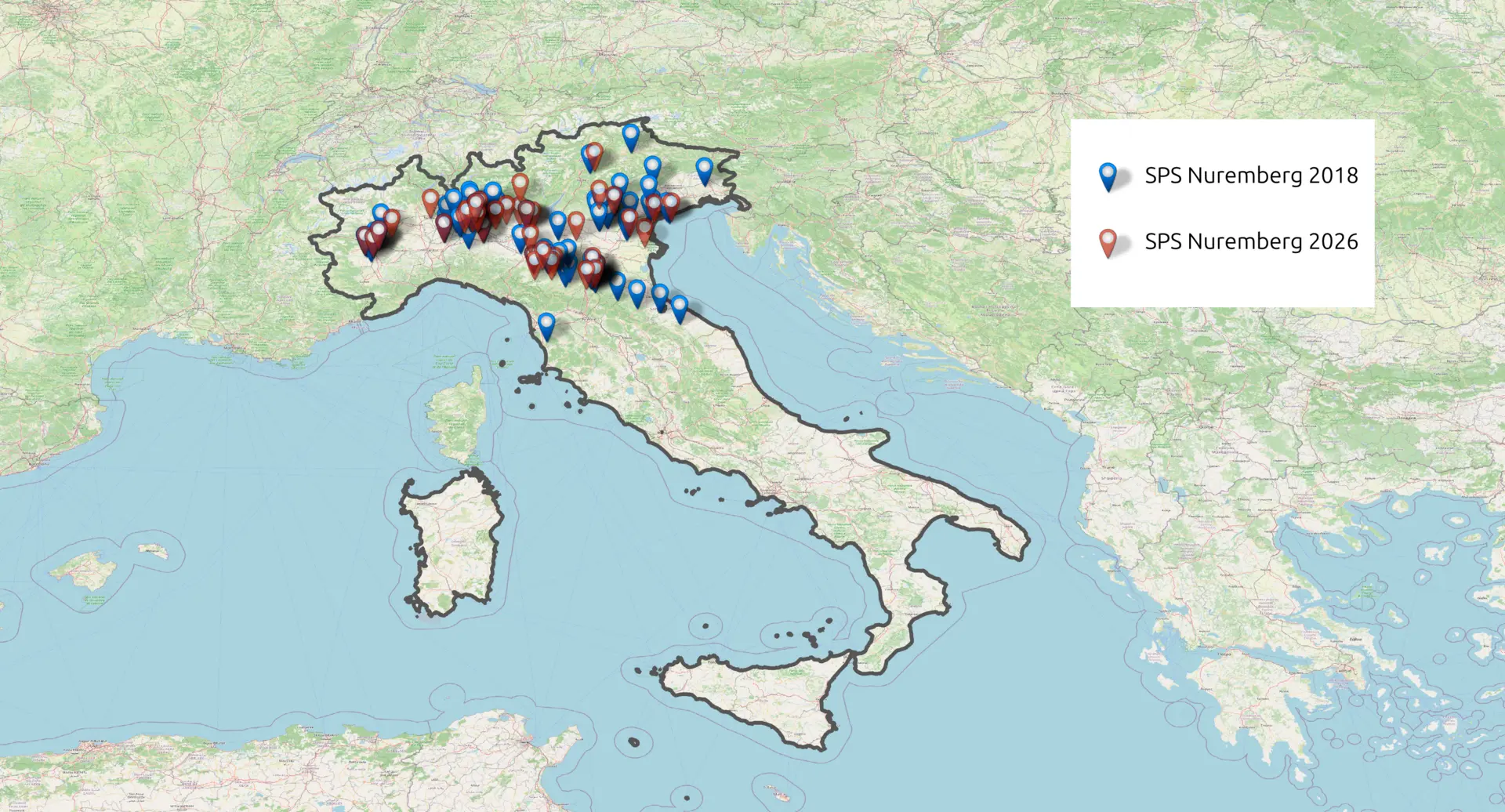
Roughly 100 Italian automation companies (blue markers), all mapped to a compact triangle between Milan, Turin, and Bologna. Not a single exhibitor south of Florence. It was the most “geeky” and visceral representation of Italy’s “Industrial North vs. Agricultural South” divide I had ever seen.
The Landscape in 2026: Persistence of Patterns
Eight years later, I decided to re-run the analysis to see if the geographical distribution of Italian exhibitors had shifted. I updated the dataset using the current list of Italian companies registered for the SPS Expo 2026 (Nuremberg). Although the current list is still growing as we approach the November event, currently capturing 40 exhibitors (Fig. 1, red markers), the visual evidence is consistent. The industrial heart of automation remains anchored in the same core regions of Northern Italy.
Data Completeness Note: The 2026 dataset presented here reflects the initial exhibitor list as of early May 2026. As the exhibition date approaches (November 2026), we anticipate further updates to the exhibitor roster. For the latest confirmed list, please refer to the official Exhibitor and products of the SPS 2026 page.
A Deeper Look at the Local Hub: SPS Italia 2026 (Parma)
While the Nuremberg data captures the global industrial landscape, this regional exhibition provides a more localized view of the Italian automation ecosystem. We have identified 423 Italian exhibitors participating in SPS Italia.
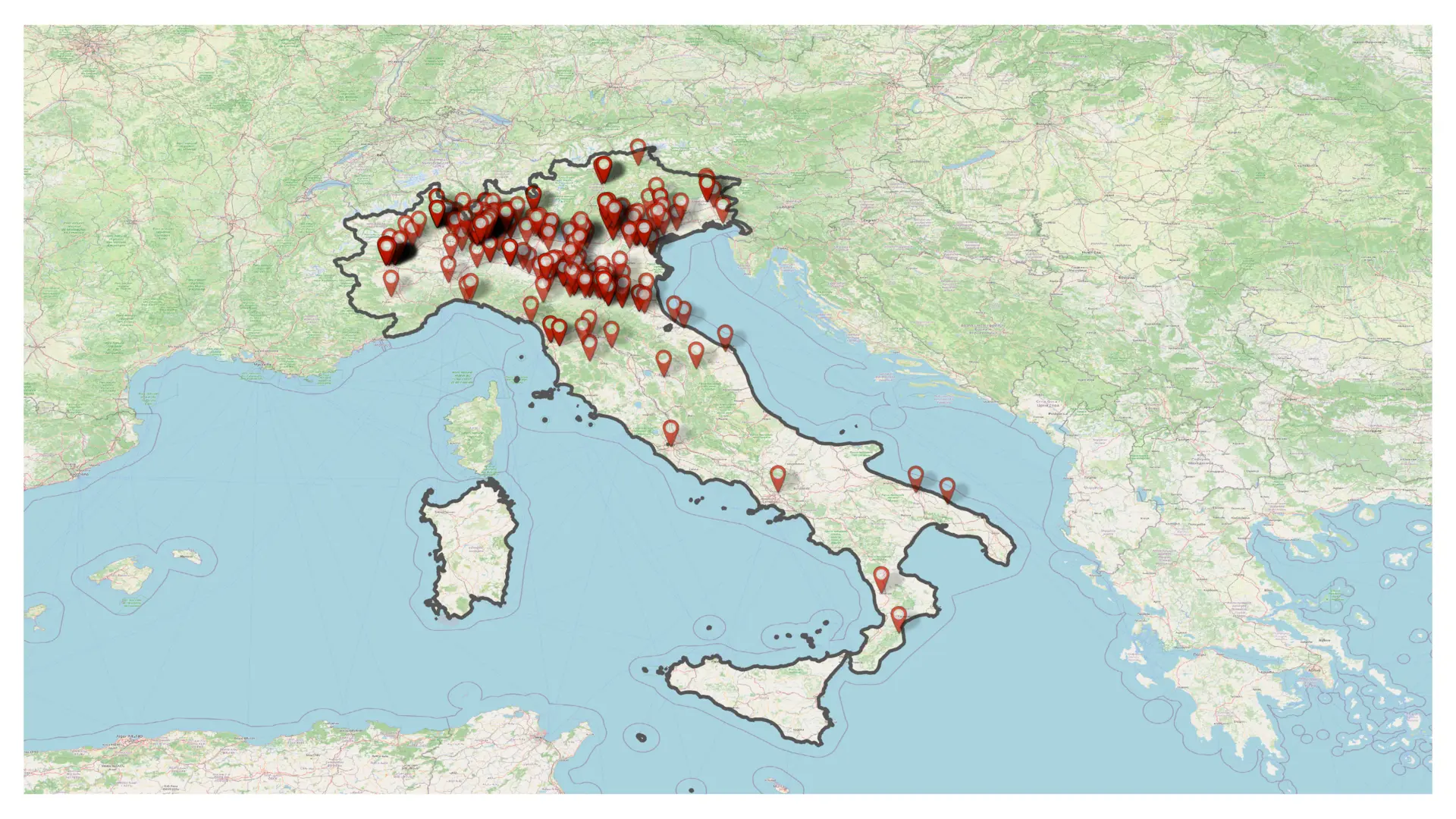
The visual evidence here is striking and consistent with our local observations. Even when we cast a wider net to include smaller players, the industrial heart of automation remains anchored in the same core regions. Central and Southern Italy show only scattered, sparse participation, with a combined total of fewer than 10 companies across the entire southern half of the country.
Conclusion: The Industrial Pulse
This geospatial perspective on industry events has proven to be an interesting analytical tool. By combining data scraping, automated geocoding, and spatial visualization, we have observed that industrial gravity is not a transient state—it is anchored in decades of localized infrastructure, logistics, and specialized education.
Looking ahead, I plan to continue monitoring the Italian automation ecosystem to see how these industrial clusters evolve. Since my base of operations is now in Montenegro, I have naturally begun to apply this same lens to the Balkan region. Identifying emerging pockets of innovation here is part of my ongoing work at Lurra Nova.
Stay tuned for further updates as I continue mapping these industrial heartbeats.